

A new museum foundation recently released a public request for proposals to a selected group of designers. The brief called for progressive, sustainable architecture and novel gallery experiences for their future visitors. The selected designer should not only demonstrate a unique aesthetic sensibility, but also a mastery of modern digital tools to help achieve efficient project delivery and sustainable design objectives.
As a consultant, I haven’t been in the design driver’s seat for over 13 years. As many of you know, I took on a career path in technology consulting. Nevertheless, I have been feeling nostalgic for my time as a designer. With this new competition, I could apply the wealth of digital skills that I have acquired through years of project consultations with some of the most creative teams in the industry.
Dusting off my design skills…
I began the design process the conventional way: I sketched! Drawing on my consulting experiences on museums like the Gilder Center and the Lucas Museum, I drew up an organic exterior geometry with large archway openings inviting the urban context into the main space. The facade creates a hard, porous shell so visitors can have access to daylight and framed views of the city as they tour the gallery spaces. To top it off – literally – a green garden roof provides the city with a new amenity for gatherings and respite.


To develop the project, I used all of the technology skills I have mastered over my career: Rhino and computational skills helped me build a powerful control system for the exterior mesh geometry. Analysis tools like Ladybug and OpenFOAM helped me use data to optimize the project concept for environmental conditions such as wind and solar conditions. And, of course, Revit was used to develop an integrated BIM with supporting documentation.


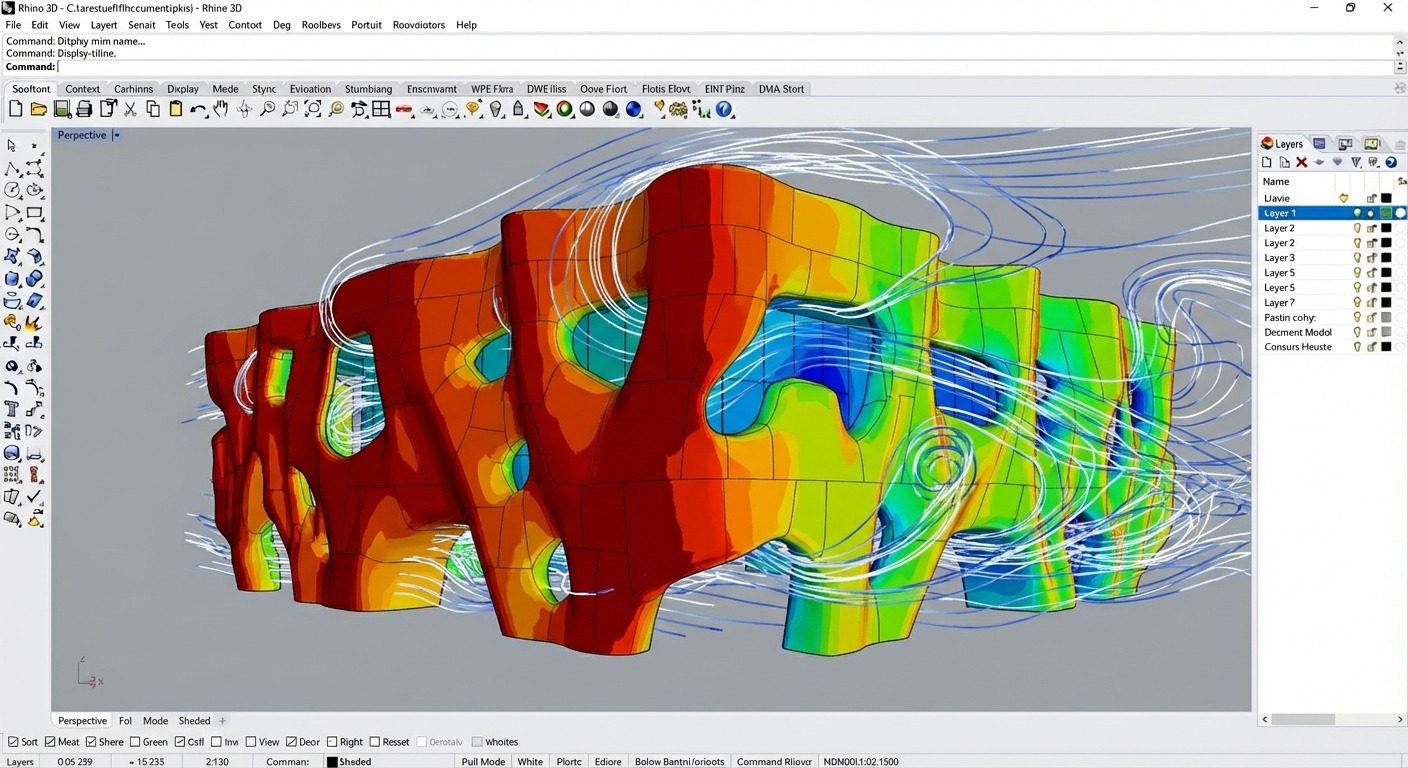

As I approached the deadline for submitting my project, I only had one tiny problem…
My project doesn’t exist.
The ‘visionary’ design sketches? The product of generative AI prompts. The ‘hero’ rendering showing the museum at dusk? AI. The screenshots of a coordinated Revit model with BIM components? AI. The computational Rhino meshes? AI. Solar analysis? AI. Wind CFD study? AI. Elevations? Plans? AI all the way down.
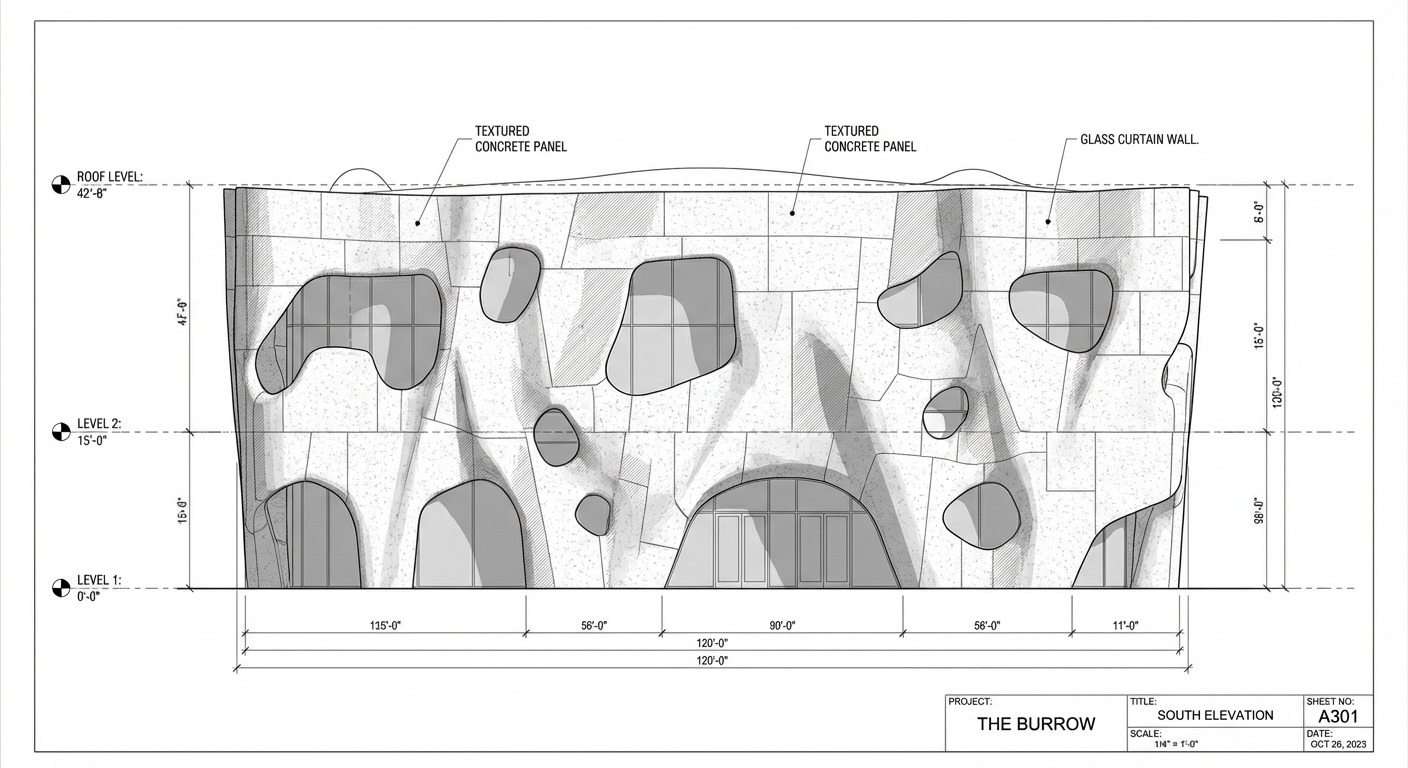
Every 3D image, rendering, sketch, analysis, and documentation for this project is a fabrication: they do not correspond to any authentic digital asset or dataset expected from a professional architect.
On closer inspection, the images are rife with errors and are very uncoordinated. Zooming in and the images reveal dimensions that don’t add up, design features that are unaligned, and vast amounts of gibberish text. (Note: I’m sure these goal posts will continue to move…) Most importantly, they are certainly not representative of any earned professional knowledge or skill that would allow me to cultivate trust with a future client.
…they are certainly not representative of any earned professional knowledge or skill that would allow me to cultivate trust with a future client.


However, these AI bloopers are likely not readily apparent when scrolling past them on LinkedIn or when performing a review of a PDF portfolio submittal. Unassuming viewers might think they are looking at products of design work that took weeks of rigorous study and were created by a technically savvy expert. Instead they are the artifacts of an artificial process directed by simple prompts and vibes.

Don’t slip on a (nano) banana peel…
In total, it took me less than 10 minutes to create all of my ‘project’ images using Nano Banana – a Gemini AI image generator. Thanks to advancements in their reasoning models, the latest releases of these tools by Google boasts new capabilities to generate sequences of images that have a degree of continuity and consistency with each other.
Not only can Gemini generate a single image from a prompt, it can take instructions to “show me a 2D plan based on this 3D image” or “render corresponding aerial view.” If you want your image to look like it came from specific software, like Rhino or Revit, Nano Banana will produce images with a UI backdrop and viewport style consistent with that software. If you want to make it appear as if you performed rigorous simulation and analysis, AI also has you covered. My ‘museum’ is not a design study: it is an attempt to see how far I could get by applying AI to fabricate something that looked like a design study.
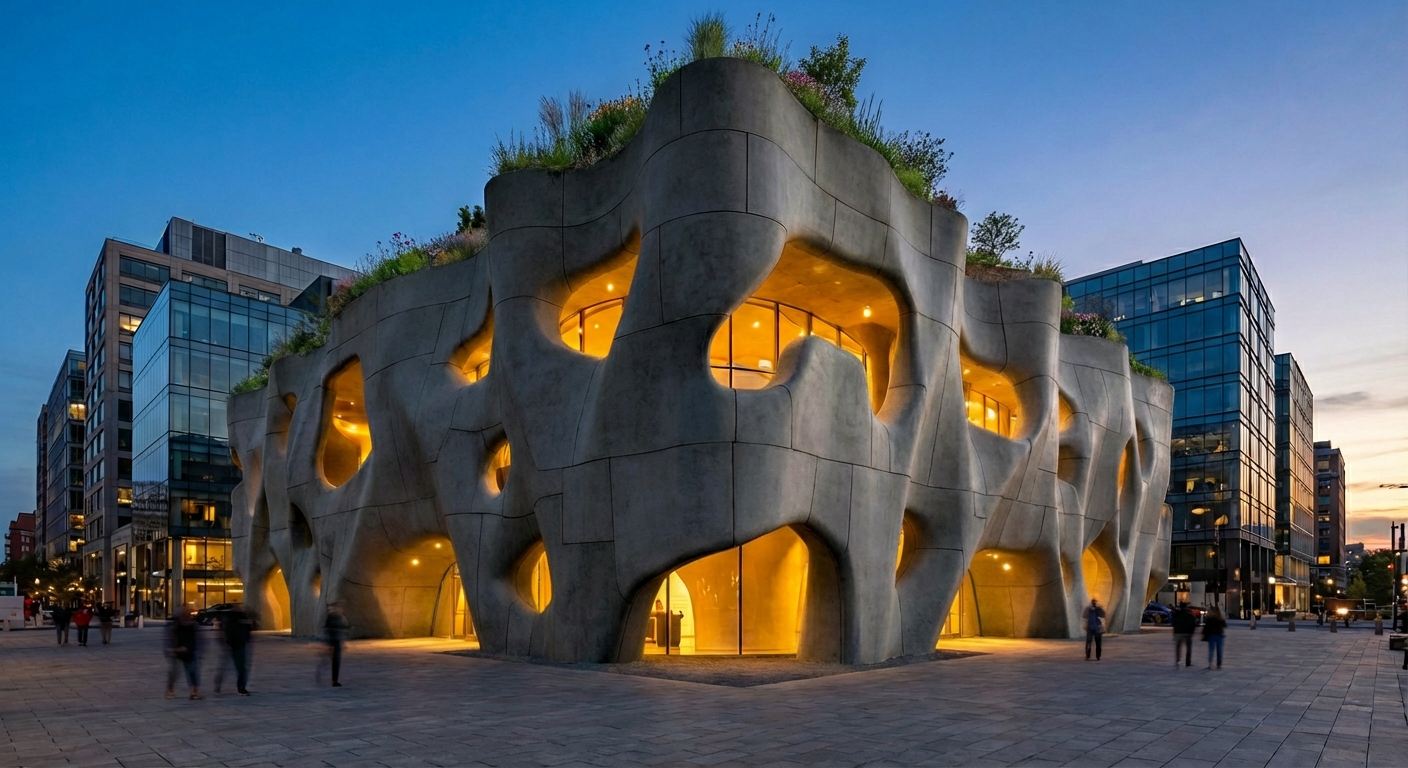
My ‘museum’ is not a design study: it is an attempt to see how far I could get by applying AI to fabricate something that looked like a design study.
As we close out the year 2025, the needle continues to move with regards to AI’s influence over the architectural design process (and many other facets of the industry… and the world at large). A popular fear has been the outright replacement of humans in various sectors of the marketplace. This however, seems a gross overestimation given what I have experienced to be serious limits in generative outputs. I remain convinced that AI will never be in a position to truly replace the creative ingenuity or technical prowess of a design professional.
However, I have become more concerned by a different kind of existential threat: the race for speed, efficiency, and ease promised by AI is in danger of giving way to a race to the bottom dominated by shortcuts, fakery, and a general devaluation of the discipline of design. AI has the potential to erode trust in professional capability through the proliferation of content that appears comparable but is ultimately hollow in authenticity, void of exacting rigor, and empty of critical thought.
AI has the potential to erode trust in professional capability through the proliferation of content that appears comparable but is ultimately hollow in authenticity, void of exacting rigor, and empty of critical thought.
In another recent blog entry, I outlined concepts and tactics where AI is confronting the ethics of architecture professionals. Standards of competence, trust-based relationships with clients, and environmental responsibility are all impacted by these new technologies. Even as AI tools become more widely used, the responsibility for their output falls on the user to ensure that professional obligations are being met. (The tech companies authoring these tools are certainly are not keen to take on liability in their license agreements.)
All of this is to say: It is incumbent on professionals to educate themselves on these tools, not only for adoption, but as a way to reaffirm the value of human skills, thinking, discipline, ingenuity, and the earned knowledge of a designer.
You may not find yourself being replaced, but you might soon find your credibility being called into question.
Writer’s note: All writing in this article is authored by a person, me! My opinions, expertise, and experiences are my own.