

Exactly one year ago, I wrote a blog piece entitled My Project Doesn’t Exist. This piece explored the growing capability of AI image generation to produce convincing architectural project imagery. Images depicting renderings, sketches, Revit screenshots, analysis output were generated in a matter of minutes with Google’s NanoBanana 2 AI model. At a glance, the images looked like a coordinated collection of content that was produced by an architectural design team. This study was so convincing, in fact, that a few followers on my social media accounts unironically congratulated me on winning a new design project.
My tests of these capabilities gave way to a larger critique of popular AI output at the time. The “project” may have looked impressive to a casual LinkedIn audience, but closer inspection of the images revealed the ruse: It was AI fakery end-to-end. The output wasn’t close to meeting the technical expectations that would be expected of a competent design professional. Moreover, I warned of a growing existential threat: the race for speed, efficiency, and ease promised by AI is in danger of giving way to a race to the bottom dominated by shortcuts, fakery, and a general devaluation of the discipline of design.
Back in 2025 the promise of an AI solution that is capable of supporting exacting tasks for developing architecture seemed far off on the horizon…
A lot has happened in one year.
The AI generation of ropey design imagery (or what my son’s generation calls “cringe”) now appears quaint when we observe it against the backdrop of new AI models equipped with advanced reasoning capabilities.
Thornton Tomasetti’s (TT) CORE Studio recently published research which assesses the ability for AI models to problem solve a series of engineering questions. They composed 91 structural engineering questions “spanning bridge loads, building loads, environmental loads, foundations, retaining walls, engineering mechanics, structural analysis, connection design, protective design, and member design in concrete, masonry, steel, and timber.” The objective of the study was to “probe code reasoning, load path understanding, numerical calculation, geometric interpretation, and engineering decision-making” of widely available versions of AI models including Claude, ChatGPT, and Gemini.

TT’s benchmarking revealed some remarkable findings. In mid-2025, frontier AI models, such as GPT-5 scored between 55%-84.6% (depending on the specific version) on the structural engineering benchmark. By mid-2026, the scores for the latest frontier models reached over 95%.
This is quite the capability jump to go from a grade of F to an A on a structural engineering exam in under a year. This context should also mean that a designer who is dabbling in AI would have a very different experience in mid-2025 than they are having today in late-2026.
Anecdotally, my own past experience testing AI for anything requiring technical exactness, such as coding, drafting, or 3D modeling, had always produced results rife with errors or outright failure. Are today’s advancements benchmarked in TT’s study having a notable impact on my own experiences with these tools? I can say this with an unequivocal yes.
But don’t take my word for it…
Recently, Rhinoceros 9 released a new AI interface that allows users to prompt AI platforms, like Claude, to perform design tasks ranging from geometric operations, script development, drawing generation, annotation application, and data extraction. Frankly, I was surprised that McNeel were going to include an AI feature with Rhino 9. The modern-day AI trend has never really seemed to be their style as a company that has prioritized building affordable software with robust geometry features on top of conventional UX.
Naturally, I was curious to see what a frontier AI agent could do in the context of Rhino.
I connected Rhino AI to a Claude agent and I began peppering the chat prompt with a variety of modeling, geometric, and computational tasks. Here are a few sample tests (simplified and generalized here for brevity)…
- Take this mesh representing a multistory building and find all of the interior space volumes, draw enclosed polylines, create clean solid extrusions.
- Take this sketch describing a geometric constraint condition and develop a C# script that exposes [x,y,z] parametric inputs and provides [a,b,c] output formats.
- Analyze this graphic standard for theater seating risers and create a Grasshopper definition that will allow me to adjust line-of-sight parameters and distances.
- Use my Rhino model and produce a presentable, annotated, and dimensionally accurate exploded axonometric diagram describing the design components.
- (Within Rhino.Inside Revit) analyze my Revit rooms and insert a standard classification ID value based on this construction standard table.

The tasks I have been testing are things I would have undertaken in my past roles as a designer or as a computational consultant. Some of them would have taken me an hour, afternoon, or day to complete. Rhino AI and Claude completed these tasks in just 1-2 minutes with output that I could easily verify.
The solutions were correct, reliable, and reusable. They were achieved at a production speed far outpacing my own extensive technical design experience and computational capability. It is easy to observe that we are entering a stage of the AI-era where technical design tasks that would have previously taken an architect days, weeks, or months to complete can now be undertaken in hours, minutes, or less.
However, it is also important to recognize that the mere existence of a powerful capability does not ensure a productive implementation that lives up to its potential. I know from experience that successful digital transformations fail on the basis of an inability to manage organizational change. Procuring software is the easy work. Equipping people with the skills, motivation, and discipline to execute a new process to achieve desired outcomes is far more daunting.
I also have to refer to my previous writings on the complicated ethical backdrop that AI presents. AI remains a technology that, as of 2026, is largely built on dubious intellectual property practices, a very poor environmental track record, requires a high degree of responsible control by those that utilize it.
Even with the larger challenges of change management and professional ethics, I believe the capabilities of AI systems to address substantial portions of a professional’s hourly work are now far too substantial to ignore. Design professionals who decide to “wait this out” and “see what happens” are now doing so at their own peril. I acknowledge that this may sound like the familiar hype found in popular media and social platforms. Given my history of commentary on this subject, I hope it caries some degree of weight.
Where do we go from here?
As we close the books on 2026, I believe design professionals need to be asking a different set of strategic considerations than they were a year ago and with greater urgency. I believe the existential question for AI today falls squarely on a professional’s ability to illustrate value: In the wake of technically exacting AI reasoning, the biggest vulnerability for creative businesses is directly tying calculations of professional value to notions of time, effort, and production capacity.
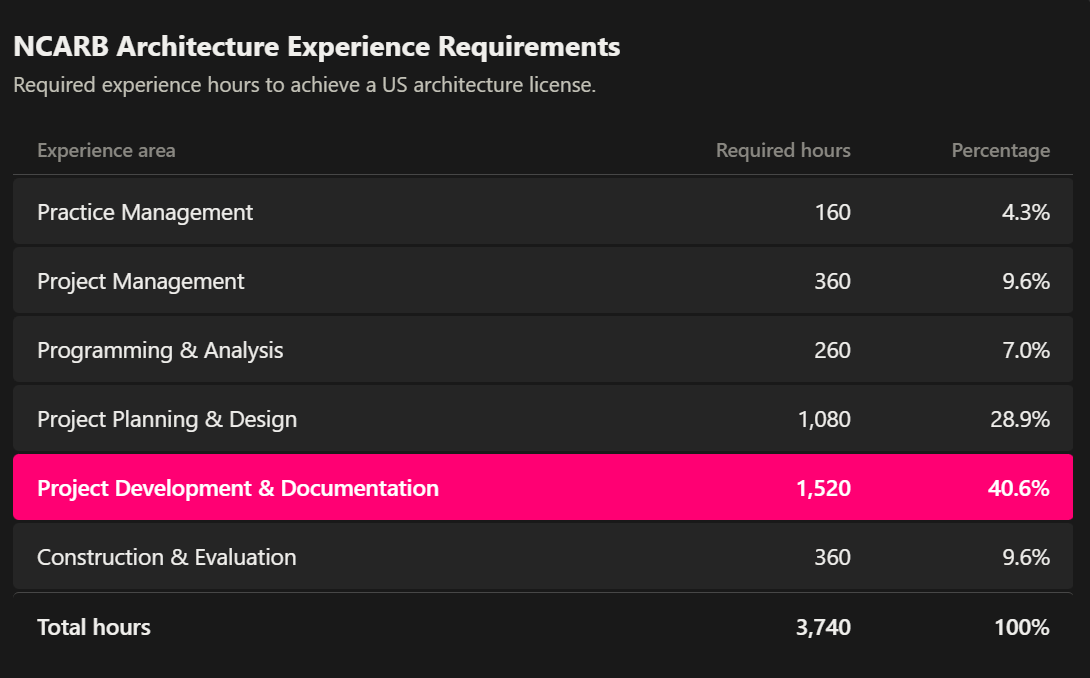
Let’s consider the following: This table presents Architecture Experience hours that are required as part of a US architect’s certification. 40% of those hours are allocated to “Project Development & Documentation”. These hours also happen to be related to tasks that account for between 40-50% of an architect’s professional fees in a typical full-service design contract: the construction documentation phase. As AI continues its trajectory of being able to handle exact technical solutions for design development and documentation, it is no question that the associated time (and fees) are at risk of being substantially reduced, if not wiped out entirely.
What happens then?
From here I have three strategic questions for you and your design organizations:
- If AI tools are capable of reliably executing sophisticated technical tasks with unprecedented speed, how will your revenue model change to frame your value for conducting design services?
- If AI tools are capable of reliably undertaking production workflows that have historically supported human learning and experience, how will you ensure you are continuing to cultivate professional growth, experience, and judgement?
- If AI tools are capable of reliably replacing the need for technical production skills for deliverables, what new skills need to be developed on your team for human-led value?
And finally: How prepared is your design organization to navigate these sweeping changes with your people, processes, and technology?
* written by a human, as always.